
Let's name what's really happening
Performance anxiety during sex feels like you're being watched even when you're alone. Your brain is narrating. Am I taking too long? Does this look weird? Should I be louder? Should I be quieter? The moment you start asking these questions, pleasure exits through a side door and doesn't come back until the pressure leaves.
Here's the thing: you can't think your way out of performance anxiety. Willpower won't fix it. Neither will reassurance from a partner, no matter how sincere. What actually works is interrupting the feedback loop. And that's where a lemon vibrator comes in.
Why performance anxiety kills pleasure in the first place
When you're anxious about how you're performing, your nervous system is running a threat assessment. Are you being judged? Will you fail? Your body responds by contracting. Blood pressure stays elevated. Muscles tense. Arousal plateaus or drops entirely. The physiological reality: anxiety and deep pleasure can't occupy the same nervous system state.
This isn't a character flaw. It's neurobiology. Your amygdala is working overtime while your prefrontal cortex (the part that actually enjoys sensation) is getting sidelined.
The secondary layer adds insult: the anxiety about not being aroused creates more anxiety. You're now performing anxiety about performance. It's a closed loop, and the only way out is to break the pattern, not fight it.
Why a lemon clitoral vibrator changes the dynamic
Three mechanical reasons a lemon vibrator like the Lem works better than other approaches when performance anxiety is in the mix.
First: It's not your body failing, it's a tool delivering consistent stimulation. The moment you switch from manual stimulation to a vibrator, the narrative shifts. Your brain isn't tracking "Am I doing this right?" anymore because you're not the one doing it. The tool is. You become the receiver of sensation, not the performer of it. That distinction is everything.
Second: The suction pattern provides novelty. Performance anxiety thrives on repetition. The same touch, the same rhythm, the same pressure. Your brain catalogues it as ordinary and keeps monitoring. A suction clitoral vibrator delivers a sensation pattern your body hasn't adapted to. This activates your sensory cortex in a way that demands attention. It's hard to worry about performance when you're genuinely surprised by what your body is responding to.
Third: It's emotionally neutral. A lemon vibrator doesn't care if you come. It doesn't have expectations. It won't be disappointed if you need to start and stop. This sounds small until you realize most performance anxiety is rooted in imagined judgment from a partner or internalized cultural messaging about what good sex should look like. A tool removes that perceived judgment entirely.
The practical setup that actually works
Let's move past theory. Here's how to use a lemon sexual toy when performance anxiety is the real issue.
Step 1: Solo first, partner second. If you're partnered, start alone. Spend 2-4 solo sessions with your clitoral vibrator before bringing a partner into it. This does two things. One: it teaches your nervous system that the lemon vibrator is safe and pleasurable, which reduces activation anxiety. Two: it gives you proof that your body can respond, which quiets the catastrophic thinking about dysfunction.
Step 2: Don't script the session. This is the anti-performance move. No "I'll use it for exactly 15 minutes" or "I'll definitely come by the end." You're trying to build comfort with not knowing what's going to happen. Set a timer for 20 minutes if you need structure, but tell yourself the outcome is irrelevant. The point is the exploring, not the arriving.
Step 3: Actually name what you're noticing. This sounds awkward, but it works. As you're using your lem vibrator, internally narrate sensations instead of judgments. "That's a buzz that travels up my left side." "That pressure feels good for about 30 seconds then goes numb." "I'm more responsive when I haven't eaten in a few hours." You're building data about your own body instead of evaluating your performance.
The partner conversation that prevents relapse
If you've got a long-term partner, the anxiety often regenerates when you introduce the vibrator into partnered sex. Here's how to navigate that without creating new pressure.
Tell them: "I'm using this to help me feel more pleasure, not because anything is wrong with what we do together." Then actually mean it. A lemon clitoral vibrator isn't a replacement for partner touch. It's a tool for your own nervous system. Frame it that way.
When you do use it with a partner present, consider not having them watch your face. Seriously. Knowing someone is monitoring your reactions for signs of success is exactly the performance condition you're trying to escape. You might ask them to focus on their own sensation, or to touch you in a different area while you're using the vibrator, or to simply be present without observing your pleasure like it's a performance metric.
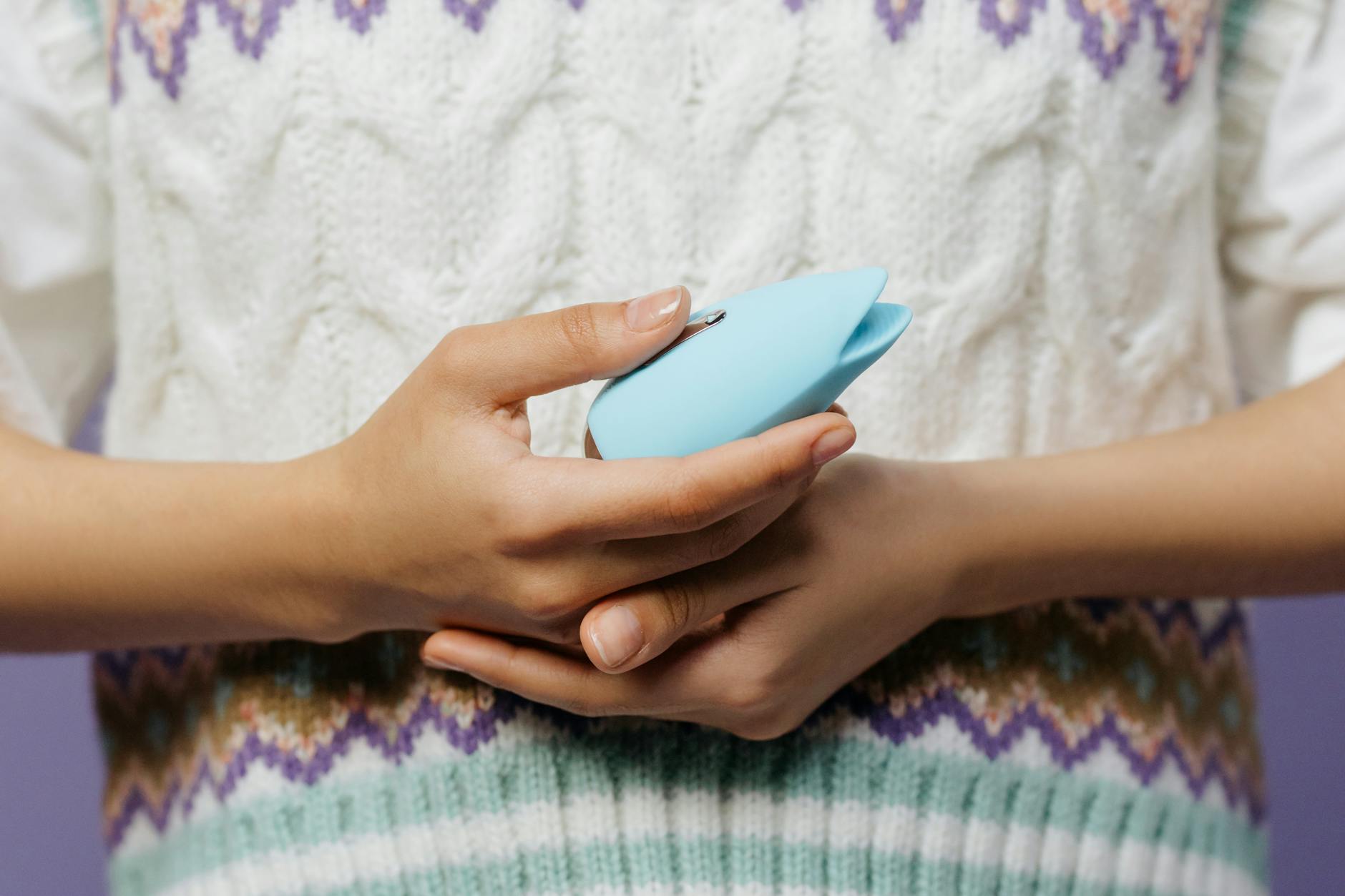
Photo by cottonbro studio on Pexels
What happens when you stop the narrative
Here's what I see happen with clients who move through performance anxiety with the help of a lemon vibrator. Around week 3, something shifts. They stop waiting for the anxiety to disappear and start just accepting it's there while exploring anyway. The anxiety doesn't leave immediately, but it stops mattering. You're not performing for the anxiety anymore.
Then, usually by week 5 or 6, clients report their most surprising discovery: the anxiety was never really about the quality of their orgasm or whether they were "doing it right." The anxiety was about trying to control something that isn't controllable. The moment you stop trying to control the outcome and just let the lemon vibrator do what it's designed to do, the whole system relaxes.
That doesn't mean orgasms suddenly appear like clockwork. It means you stop needing them to in order to call the experience successful. And paradoxically, that's usually when they show up more easily.
When to reach for other tools
If you've been using a lemon clitoral vibrator solo for 2-3 weeks and the anxiety is still completely blocking sensation, it might be worth checking in with why. Sometimes performance anxiety is actually something else wearing a different costume. It could be relationship tension you haven't addressed. It could be unprocessed grief or stress. It could be that you need to explore pleasure at your own pace with a longer runway than you've given yourself.
There's also a difference between the normal jitteriness of trying something new and a level of anxiety that's genuinely blocking all sensation. If you're in the latter camp, a conversation with a therapist who works with sexual anxiety is worth having. Sometimes the tool helps. Sometimes you need both the tool and some talk therapy.
What actually gets better
Performance anxiety doesn't usually vanish overnight. But what changes is your relationship to it. You stop believing it's evidence that something is wrong with your body or your capacity for pleasure. You start seeing it as nervous system noise that's separate from what your body can actually feel.
A lemon sexual toy, specifically the suction vibrators like those from Hellanancy's Lemons, helps because it literally gives your nervous system something else to focus on besides the performance narrative. You become a body that's being pleased rather than a person who's trying to perform pleasure.
That shift is where real change lives.
Common questions about vibrators and anxiety
Can using a vibrator make anxiety worse if I'm already worried about performance?
Not if you approach it as exploration rather than another performance test. The key is removing expectations about what should happen. If you use the vibrator and think "I have to prove my body works now," you've just moved the performance stage. Use it as data collection. What happens when you're not trying to make anything happen?
Should I hide the vibrator from my partner or be open about it?
Transparency is almost always better for anxiety long-term. Hiding it creates a secondary anxiety layer (what if they find it, what if they judge me). Being open gives you permission to explore without a second job of managing secrets. That said, your comfort comes first. If you need a few solo weeks before mentioning it, that's fine. But the eventual move toward openness usually eases anxiety faster than secrecy does.
How long before I stop feeling self-conscious using a vibrator?
Most people report that self-consciousness drops sharply after 3-5 solo uses. Your nervous system realizes there's no danger, and the brain chatter quiets. By week 2, it usually feels normal. If it doesn't, you might be dealing with shame that goes deeper than performance anxiety. That's worth exploring separately.
Will using a lemon vibrator make me dependent on it for pleasure?
Not in any concerning way. Yes, vibrators are more efficient at delivering stimulation than fingers or a partner's touch. But efficiency doesn't create dependency. You depend on toothpaste because it works better than not using toothpaste, not because you've become addicted to the minty flavor. A lemon clitoral vibrator is a tool that works. Using it doesn't mean your body can't respond to other kinds of touch. It just means you've got one effective option in your toolkit.
What if I still feel anxious even with the vibrator?
The vibrator is removing one variable. If anxiety persists, you're likely dealing with something beyond the sexual moment. That might be relationship stress, general anxiety disorder, past trauma, or simply that you need more time and practice. A vibrator isn't therapy. If the anxiety is intense and persistent, getting support from someone trained in sexual anxiety is worth the investment.
Can my partner use the lemon vibrator on me if I have performance anxiety?
Yes, but with a caveat. If the anxiety is rooted in feeling watched or judged, having a partner operate the tool might not help initially. Start with solo use so your nervous system learns the tool is safe. Then introduce partner use once you've built some comfort. When a partner does use it on you, the same principle applies: remove the performance element by not making their touch or the vibrator about producing an outcome.
The bigger picture
Performance anxiety is one of the most common reasons people avoid pleasure entirely. Not because they can't feel good, but because the pressure to feel good blocks the actual feeling. A lemon vibrator doesn't solve performance anxiety by making you feel worse about it or by forcing a better outcome. It solves it by removing you from the position of performer and putting you firmly in the position of someone being pleased.
That shift in role is where real change starts. Everything else builds from there.