
Let's start with the obvious problem
You and your partner have different bodies. Different nerve endings. Different histories with pleasure. And honestly? Wildly different ideas about what feels good. One of you reaches for intensity right away. The other needs to ease in. Neither is wrong. But figuring out how to use a lemon vibrator together without one person white-knuckling through discomfort or the other feeling bored is a conversation most couples never actually have.
Here's the thing nobody tells you: sensitivity differences are not a flaw in your relationship. They're just information. And once you know how to use that information, a lemon clitoral vibrator becomes a tool that works better together than it ever could alone.
Why sensitivity differences matter more than you think
Sensitivity isn't a fixed trait. It changes with stress, cycle phase, medication, blood flow, and honestly, how much your brain is in the room versus worrying about the grocery list. But there's also baseline variation between partners that's worth naming.
Clitoral suction technology like the Lem works by creating a gentle seal and pulsing air patterns. The intensity is customizable, which means theoretically both of you should be able to use it. But "customizable" only helps if you're actually using different settings. Most couples I work with default to one mode and hope the other person is having fun too. Then they're confused why someone's not into it.
The fix isn't complicated. It requires three conversations and one piece of logistics.
Conversation 1. Map what you actually like (separately first)
Don't do this in bed. Seriously. Do it over coffee or in the car or literally anywhere you're not already aroused and trying not to disappoint each other.
Each of you answers these questions alone, then shares.
- What setting on a lemon vibrator have you tried, and how did it feel? (If you haven't tried one, what intensity are you drawn to in other toys or touch?)
- Does higher intensity feel better, or does it become uncomfortable past a certain point?
- If you could change one thing about how you experience pleasure with your partner right now, what would it be?
The third question is doing a lot of work here. It's not asking "do you like this toy?" It's asking "what's missing for me?" Sometimes the answer is intensity. Sometimes it's time. Sometimes it's permission to focus on your own sensation instead of managing your partner's experience.
Write these down. You're going to refer back to them.
Conversation 2. Establish a shared language for sensation
Instead of "more" or "less," use this framework. It takes thirty seconds to agree on it, and it removes the guessing game entirely.
Light. Barely perceptible. Like someone's fingertip tracing your skin.
Medium. Clear sensation without being intense. Pleasant, building, sustainable for 10+ minutes without fatigue.
Strong. Noticeable intensity. Good for shorter bursts or for someone who wants rapid buildup. Not sustainable indefinitely without needing a break.
Peak. Maximum intensity. A few minutes max, usually right before or during orgasm.
Now the conversation becomes concrete. "I want to start at light and build to medium" is incomparably clearer than "not too much." And "I'm good at strong the whole time" tells your partner something useful about your arousal pattern.
If you're using a lemon clitoral vibrator, most devices have 3-5 settings. Map them together. "Okay, so setting 1 is light for both of us, setting 2 is medium for you and strong for me, and we'll rarely go to setting 3."
This removes the conversation from the moment. You already know the answer.
Conversation 3. Decide whose pleasure leads
Here's where most couples get stuck. You start using the vibrator, and suddenly someone's asking "is this okay?" mid-session, and the whole thing derails into a confidence conversation.
Instead, decide in advance: whose sensation are you tuning into right now?
Some nights the answer is "the person with the vulva using the vibrator directly." They're in charge of what feels good. Their partner is present, supporting, maybe participating, but not driving the intensity choice.
Other nights it might be "the person receiving suction" (regardless of geometry). Or even "both of us, and we'll communicate in real time."
The key is that you've decided this before clothes come off. Then during, there's no ambiguity. You know whose feedback matters most in that moment.
For partners with very different sensitivity levels, I often recommend alternating focus nights. One session is about your more sensitive partner's preferences. Next time, it's about your more intensity-loving partner. Both of you get a night where it's calibrated for you. Both of you get a night where you're supporting someone else's pleasure without trying to find a middle ground that half-satisfies both of you.
The actual mechanics of using it together
Let's say one of you is more sensitive and prefers settings 1-2. The other wants to live in setting 3. How do you both win?
Option 1. Take turns. You each get the vibrator for 5-10 minutes at your preferred setting. Your partner is present, touching you, kissing you, building connection while you're focused on sensation. Then you switch. This is actually more intimate than you'd think, because you're witnessing each other's pleasure instead of trying to manage it.
Option 2. Use it on your more sensitive partner first. Start at their preferred intensity. Build to their orgasm. Once they've come, if you want more stimulation, switch settings or pass the vibrator to your partner. There's something hot about coming first and then watching your partner get what they need.
Option 3. Get two lemon vibrators. Okay, this sounds like overkill, but if you're using a lemon clitoral vibrator regularly with a partner and you have genuinely different needs, having one for each person changes everything. You're not negotiating settings mid-session. You're not one person waiting. You're both getting exactly what your body wants. If this feels like a lot, start with sharing one vibrator and try this later.
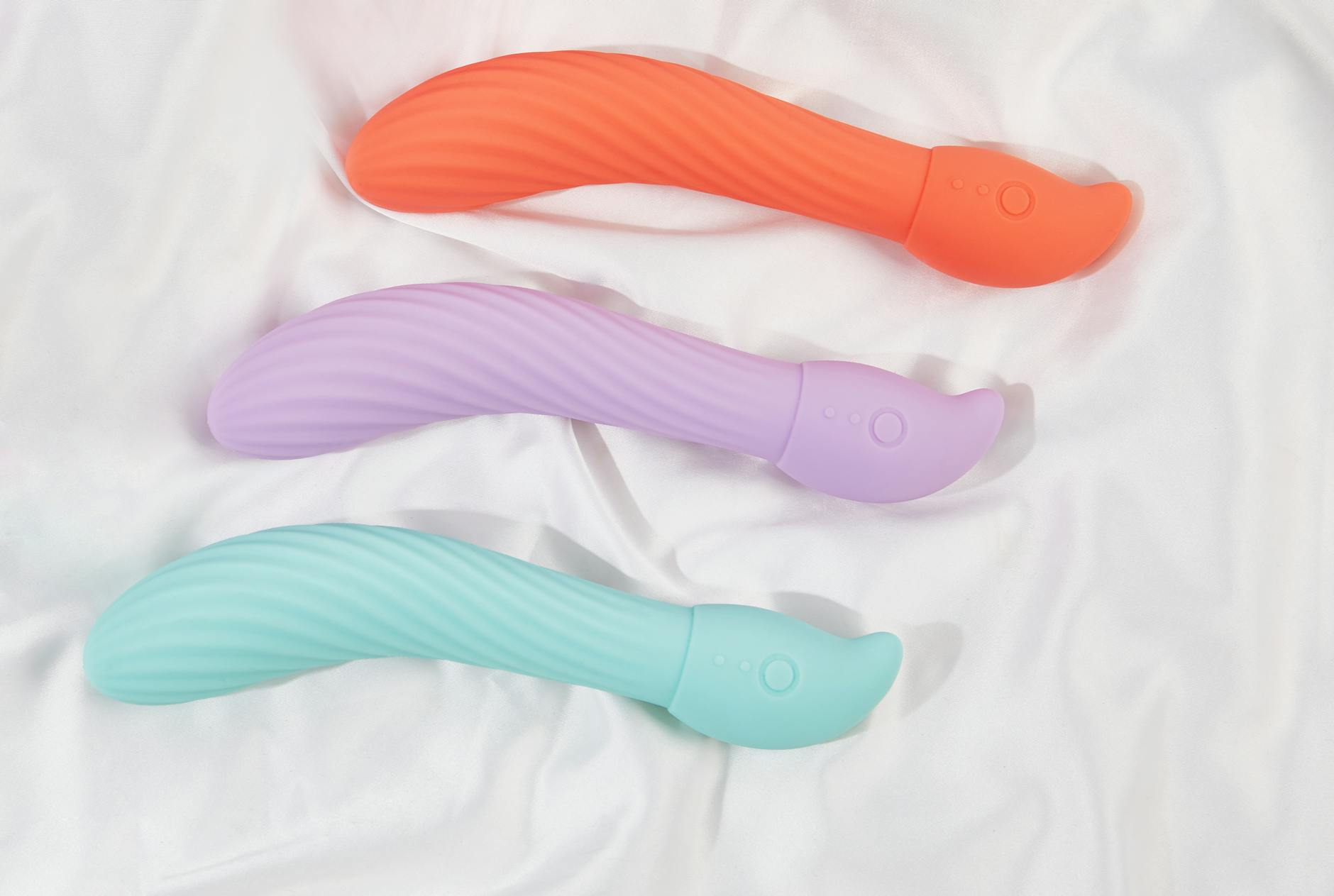
Photo by IFONNX Toys on Pexels
The communication that happens during
Once you're in the moment, keep feedback simple and real.
"That feels incredible right now" is information. So is "can we stay here for a minute?" or "I want to go a bit stronger."
The most important thing I tell couples is this: if you've done the conversations above, you already know the broad strokes of what your partner wants. During sex, you're just fine-tuning. You're not discovering for the first time that they hate what you're doing. You've already established the map.
If someone does say "actually, can we change settings?" treat it like weather information, not criticism. "Got it, turning it down" is all you need. No apology, no "I should have known." Just adjustment.
Why lemon clitoral vibrators are particularly good for this
Traditional vibrators are either on or off. Suction-based technology like a lemon vibrator gives you graduated control without sacrificing sensation. For partners with different sensitivity needs, this matters.
You can also use suction technology in different ways. Some partners enjoy the suction sensation directly on the clitoris. Others prefer it through a layer of fabric. Some like the vibration component emphasized. Others want pure suction.
This flexibility means you're not buying different toys for different people. You're learning to use one tool in multiple ways.
If you're new to clitoral suction, start with lower settings and work up. Most people assume higher setting equals better. Often it's the opposite, especially for someone with higher baseline sensitivity.
When sensitivity differences point to something bigger
Sometimes very different sensitivity levels are just anatomy. Sometimes they're a signal.
If one partner suddenly becomes much less sensitive than they used to be, that can indicate medication changes, hormonal shifts, or sometimes stress and disconnection. If one partner has always needed very high intensity and your partner finds that unsettling, that's worth exploring with curiosity, not judgment.
Sensitivity differences aren't problems. But they're also rarely a coincidence. They're usually your body telling you something about health, history, or emotional state.
If sensitivity changes are bothering you, or if one of you has antidepressants affecting pleasure, that's worth talking about separately from the mechanics of using a toy.
The real win
Most couples avoid using vibrators together because they're afraid of highlighting differences. You do the opposite. You name the differences clearly. You plan around them. You make sure both people get exactly what they need.
That's not compromise. That's partnership. And it's hot.
People also ask
Can I use the same lemon vibrator if my partner and I have totally different sensitivities?
Absolutely. The settings exist for exactly this reason. What matters is that you've talked about which setting works for whom and you're actually switching between them. If one of you always defaults to your preferred setting without asking, then yeah, it's not working equally. But if you're intentionally alternating or taking turns at different intensities, one vibrator works fine.
What if my partner thinks my sensitivity needs are too much or too little?
That's worth unpacking, because it might not be about the vibrator. Sometimes when a partner critiques sensitivity preferences, they're actually expressing something else. "You need too much stimulation" can mean "I feel like I'm not enough" or "I'm worried this means something is wrong with you." Those conversations deserve a separate time and place from sex. But on the toy front, your sensitivity is not a problem to fix. It's just information your partner needs to work with.
Is it normal for lemon clitoral vibrators to feel different depending on my cycle?
Completely normal. Hormonal changes affect blood flow and tissue thickness. Some people find clitoral suction feels more intense during certain cycle phases. This is actually useful information. You might use settings 1-2 some weeks and 2-3 other weeks. That's not a malfunction, it's your body. The good news is that lemon vibrators' graduated settings let you adjust for that.
My partner wants to use the vibrator during penetrative sex, but I find it overwhelming. What do we do?
You've just identified that the issue isn't the vibrator, it's the combination. Some people love vibrator plus penetration. Others feel overstimulated. Instead of assuming one of you is wrong, try: lower vibrator intensity, longer warm-up before adding penetration, or using the vibrator at a different point in sex (start with it, switch to penetration, come back to it). You're solving for what feels good for both people, not forcing a one-size-fits-all approach.
How do I know if my partner's low sensitivity is something we should worry about?
Low baseline sensitivity is not inherently a problem. But if someone used to be more sensitive and isn't anymore, or if they're experiencing pain or numbness alongside low sensation, that's worth mentioning to a doctor. Nerve issues, medication side effects, or hormonal changes can all affect sensitivity. A lemon vibrator won't fix an underlying medical issue, but it can work beautifully once you understand what's actually happening.
Can sensitivity issues in bed affect our overall relationship?
Sometimes. If one person feels unheard about what they need, that resentment leaks into other areas. If one partner feels judged for having a different body response, that erodes trust. But here's the good news: if you handle sensitivity differences with curiosity instead of criticism, they usually become a strength. You learn to really listen. You stop assuming. You get better at asking for what you need. That's a relationship skill that works everywhere.
Remember this: your bodies are different. That's not a problem. That's just biology. The couples who make it work aren't the ones pretending to have the same sensitivity. They're the ones who talk about it clearly, plan around it, and let their lemon vibrator work at the intensity that actually feels good for each person. That's when sex gets better for both of you.